The Difference Between Analyzing an Ad and Checking One
We tend to assume that if a tool can impress us once, it can be trusted every time. Usually it is the opposite.
I saw a post this week from an operator with serious numbers behind them: “Claude makes 20 Meta ads in minutes. One connector turns 1 winning ad into 20 of yours.” Twenty-two tools, five stages, paste a URL. It is a genuinely good build, and the enthusiasm is earned.
But one line in it stuck with me more than the rest. It described “the exact point where it stops and hands the decision back to you.” The whole thing is built to generate, at speed, and then hand the judgment back to a human. Which quietly admits the thing nobody wants to say out loud: the generating is the easy part now. The deciding, the checking, the part where someone has to trust the output before spending real money, that still lands on a person.
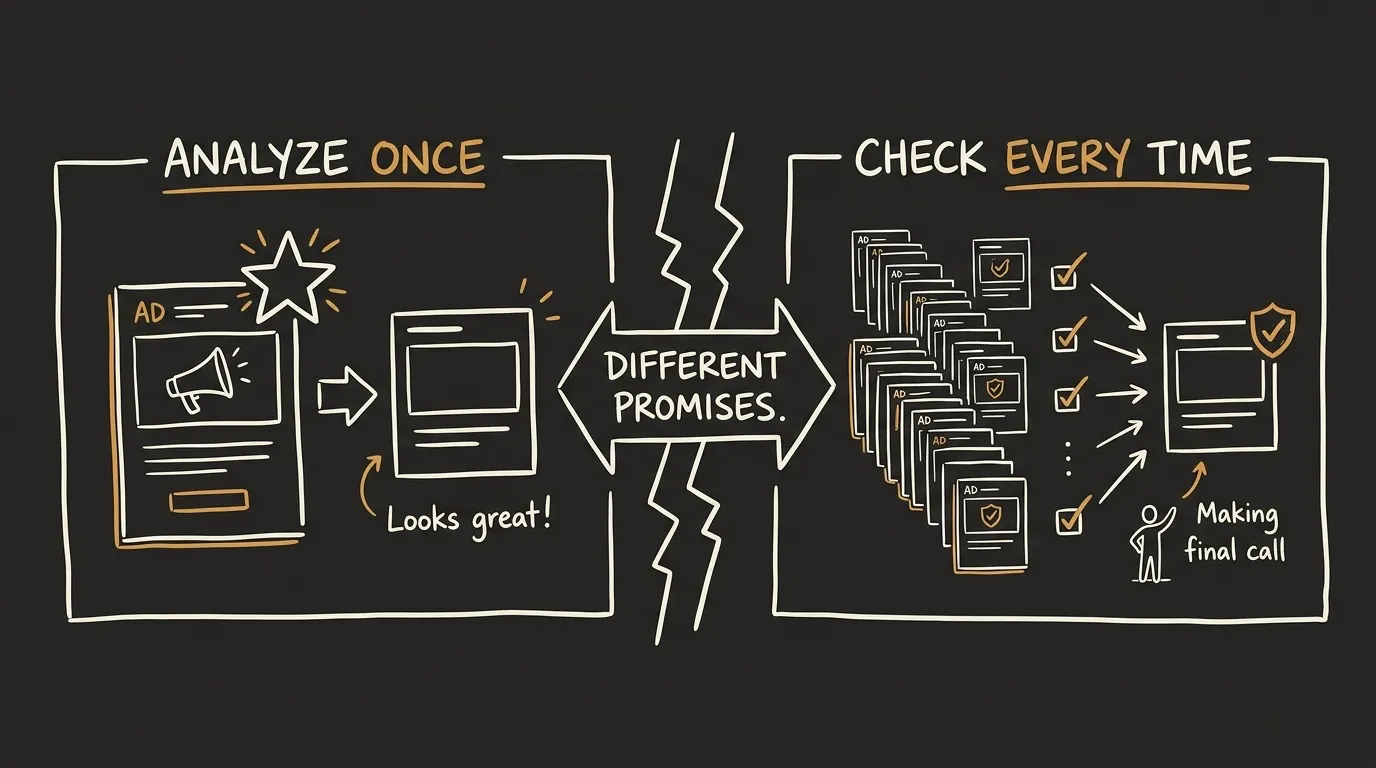
That is the gap we keep collapsing. “AI can analyze this” is a statement about capability. “AI can be trusted to check this” is a statement about reliability. The first is about what happens when it works. The second is about what happens when it doesn’t. A demo only ever shows you the first.
I build in this exact space, so I have spent a lot of time in the gap between the two. Three things live there.
The first is about what the tool can actually see. An ad is a video, and the things that decide whether it works live in time. The hook in the first two seconds. The CTA at the end. The caption that contradicts the voiceover. Hand that video to a tool that reads text and images, and what it really receives is a few frames and a transcript. It gives you a confident read of the ad. It never saw the ad. It saw the shadow. That is not a prompt you can improve your way out of. It is a limit of what the modality can perceive.
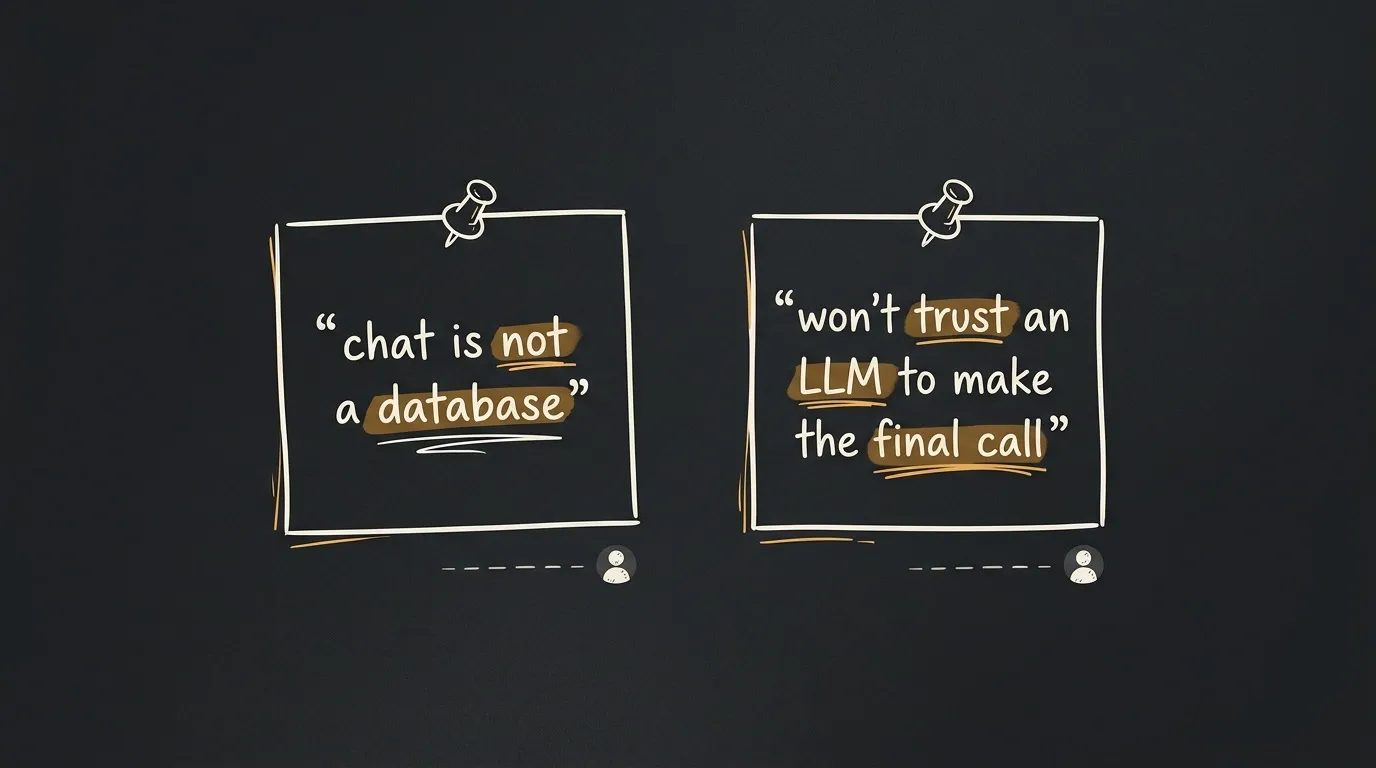
The second is stranger, and easier to miss. We assume a checker is, by definition, reliable. But large models are probabilistic. Run the same input twice, even at temperature zero, and some answers change. The model does not enforce your rules. It makes a confident guess, and it will be confidently wrong without ever telling you it wasn’t sure. For creative work, that variability is a feature. For a check, it is the whole problem. A checker that can invent a finding isn’t giving you evidence. It is giving you something that looks like evidence, which is worse, because you will act on it.
The operators who do this seriously already know it. One creative strategist who runs QA across health and fintech accounts told me he automates the low-stakes checks but keeps the high-stakes ones manual, because, in his words, he still won’t “trust an LLM to make the final call on something that gets an account pulled.” He is not being a Luddite. He has done the math: the cost of automating that wrong is higher than the minutes it saves. That instinct is the correct one, and it points at how the tool should behave. The model flags. The human decides. The model is never the final word.
The third only shows up at scale, which is why the demo never reveals it. One ad in a chat window gets a great answer. Forty ads get forty answers, each in slightly different language, with categories that drift and no way to line them up. The real skill was never in the tool. It was in the person driving it, the one who knew the right prompt and could tell when the output was off. That person is the actual quality layer. When they get busy, the checks get worse. When they leave, the checks leave with them. A capability that lives in one person’s head is not a process. It is a dependency.
None of this makes the skills bad. It makes them a different tool for a different job. Most of them are built to generate, and generation rewards range: divergent, creative, no single right answer. Checking is the opposite discipline. It is convergent, literal, and it has to be correct. Asking the tool that is best at inventing options to also be the one that verifies them is asking one instinct to do the work of its opposite.
Which points at the thing hiding under all the excitement. The faster we get at generating creative, the more of it goes out the door with no independent check. The bottleneck quietly moves from making the work to trusting it. And trust is not a demo problem. It is a systems problem: the model flags, something deterministic validates, and a human still makes the final call.
That is the line I ended up building on rather than shipping a skill. Not because a skill can’t say something smart about an ad. Because saying something smart once and being trusted every time are different promises, and only one of them is a product.
If you run paid social and want to see where that check holds up and where it doesn’t, Preflite is in free beta at preflite.info.